
How to Choose the Right Countertop Material
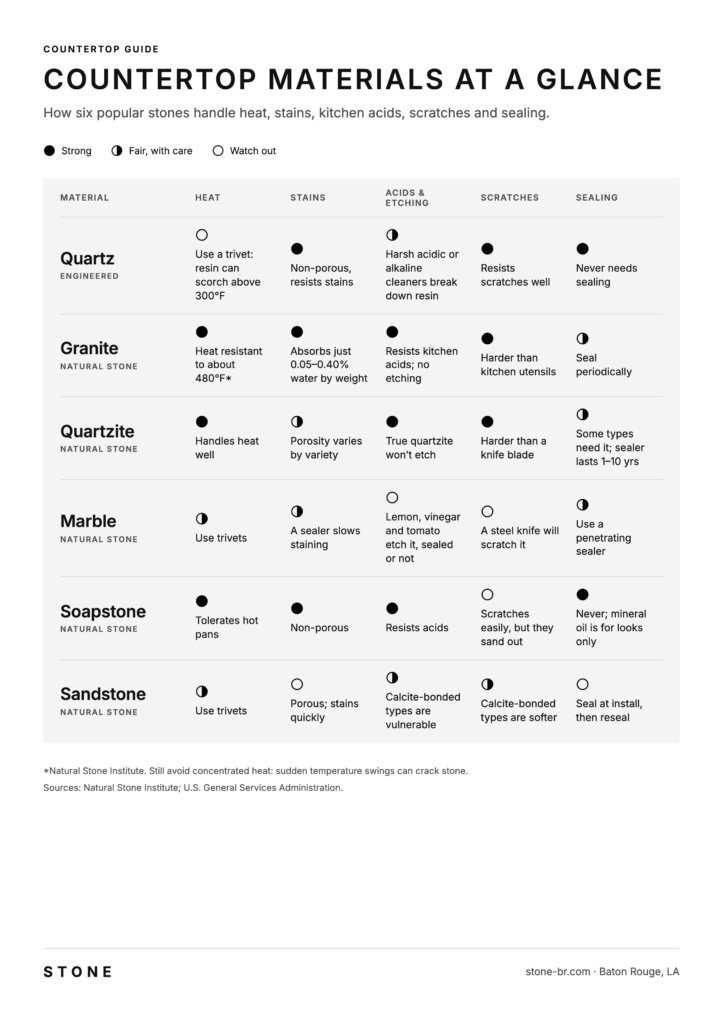
At STONE in Baton Rouge, we know countertops are where life happens: morning coffee, homework, happy hour, and the gumbo everyone requests during the first cold front of football season. Learning how to choose a countertop material starts with matching each stone’s weak spot to your habits. Quartz resists stains, but its resin can scorch under a hot pan. Granite handles heat and needs occasional sealing. Marble etches from lemon juice whether or not it is sealed. Quartzite and soapstone fill the space between. Before you fall in love with a particular type of stone, think about how you use the room:
- You cook often and cook hot. Look at granite, quartzite, or soapstone.
- You have little kids, or a habit of spilling coffee. A non-porous, low-maintenance surface like quartz saves you work.
- You want a natural, high-end look and accept some patina. Marble stays on the list.
The sections below answer the head-to-head questions Baton Rouge homeowners ask us most. Each one opens with our verdict.
Granite vs. Quartz
STONE’s Verdict: Choose quartz if you want a surface that never needs sealing and shrugs off stains. Choose granite if you set hot pans down and want a one-of-a-kind natural slab. Both resist scratches well, so the decision turns on heat tolerance against upkeep.
In the granite vs quartz countertops debate, the difference starts with what each material is. Quartz is engineered: a combination of loose quartz, resin, and pigmentation. That resin makes quartz non-porous, so it never needs sealing, which can also be a weak point. Temperatures above 300°F can damage the resin, leaving burn marks that are often permanent, and both acidic and alkaline cleaners can break the resin down.
Granite is a quarried natural stone, built mostly from quartz and feldspar. The Natural Stone Institute rates it heat resistant to roughly 480°F and lists its water absorption at 0.05% to 0.40% by weight, which leaves little room for stains. It still recommends against concentrated heat, since sharp temperature differences can crack the stone. Every slab is unique, and periodic sealing keeps it stain-resistant.

Best for: Quartz suits families and busy kitchens that want low upkeep. Granite suits cooks who want natural stone with durability and distinct patterning.
Quartz vs. Quartzite
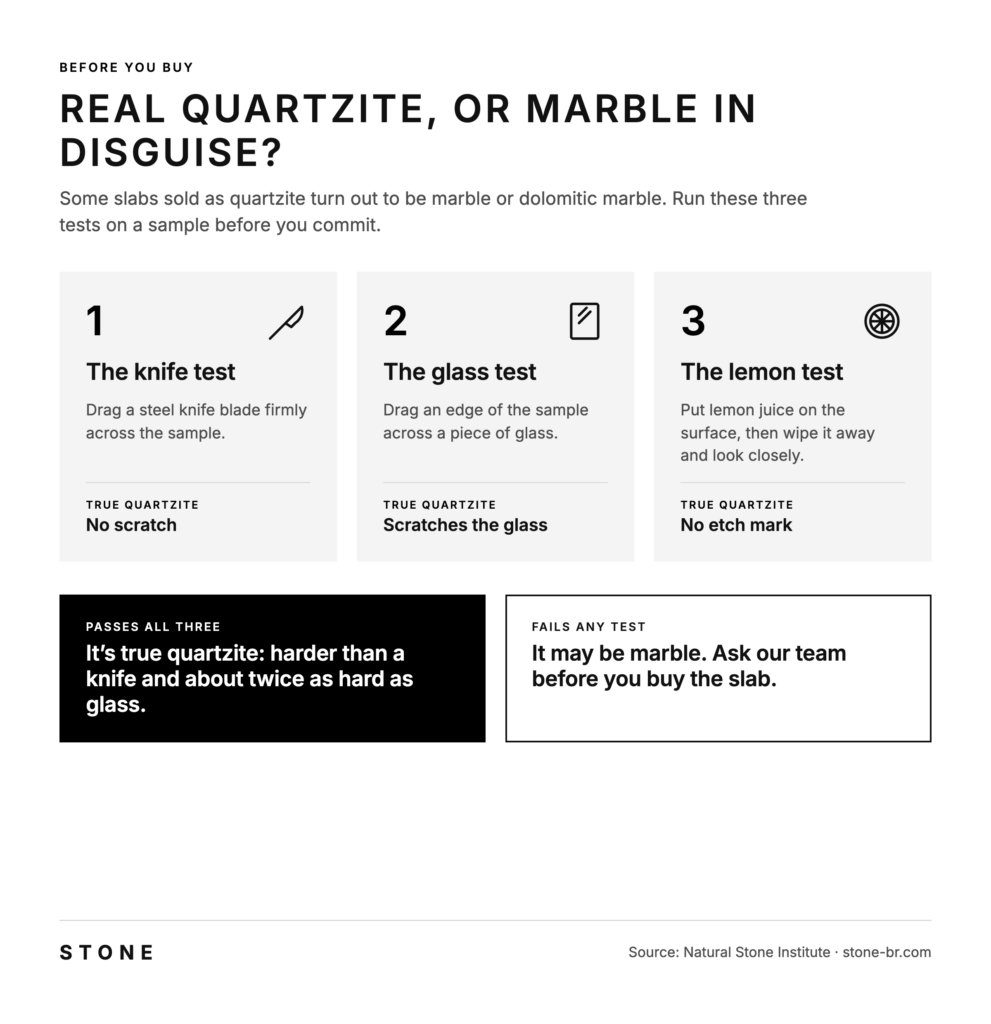
STONE’s Verdict: Quartzite is a natural stone, and quartz is engineered. Pick quartzite for heat tolerance and genuine marble-like veining. Pick quartz for the lowest maintenance and the widest color range. Before you commit to quartzite, test the slab, because stones sold as “soft quartzite” often turn out to be marble.
The names sound alike, so the quartz vs quartzite question confuses plenty of buyers. Quartzite begins as sandstone and recrystallizes under heat and pressure. The Natural Stone Institute’s consumer site describes it as having a look often similar to marble and durability comparable to granite. True quartzite will not etch from lemon juice or vinegar. Its porosity varies by variety: some, such as White Macaubas, benefit from a sealer that lasts one to ten years.
Mislabeling is the real risk. The same source warns that some slabs sold as quartzite are marble or dolomitic marble. On a sample, see whether a knife blade scratches it, whether it scratches glass, and whether lemon juice leaves an etch mark. A true quartzite passes all three.
Quartz trades that natural character for predictability. It needs no sealing and resists staining, but its resin limits heat tolerance.
Best for: Quartzite suits homeowners who love the look of marble but need something tougher. Quartz suits anyone who wants a stunning surface with no maintenance schedule.
Marble vs. Granite
STONE’s Verdict: Granite wins on durability. It is harder, handles more heat, and does not etch from kitchen acids. Marble wins on dramatic veining and how easily it can be shaped. Choose marble if you love its character and accept a patina that develops over time.
Marble is a calcium carbonate stone, and acids dissolve it. The U.S. General Services Administration notes that acidic substances dissolve portions of calcareous stones such as marble and limestone. In a kitchen, that means lemon juice, vinegar, and tomato sauce can leave dull etch marks. Sealing helps with stains but does not protect against acid. Marble is also softer, so a steel knife blade will scratch it.
If marble is your choice, three habits keep it looking its best:
- Stick with white marble. Etch marks read as pale, dull spots, which stand out more on colored marble than on white.
- Consider a honed finish. Small etches on a honed surface can often be buffed out with a marble polishing powder and some elbow grease.
- Seal with a penetrating sealer. It will not stop etching, but it slows staining.

Marble’s softness has an upside. It carves easily, which is why sculptors have favored it for centuries, and it takes curved edges well. Look through every edge profile STONE offers before you decide.
Granite, by contrast, is built mostly from quartz and feldspar, minerals that tend to resist acids. The Natural Stone Institute calls it one of the hardest dimension stones, harder than typical kitchen utensils.
Best for: Marble suits design lovers who welcome a lived-in patina. Granite suits busy kitchens that want natural stone without the caution.
Soapstone vs. Sandstone
STONE’s Verdict: Soapstone is the stronger kitchen countertop. It is non-porous, never needs sealing, and tolerates hot pans. Sandstone is porous and stains quickly unless it is sealed and resealed with discipline. Reserve sandstone for low-spill areas where its texture matters more than stain resistance.
Soapstone owes its soft, velvety feel to talc. Architectural-grade soapstone used for countertops contains mostly talc, with other minerals supplying strength. Fabricators often describe it as non-porous, unaffected by heat, and easy to refinish: scratches sand out, and many owners keep them as patina. Mineral oil darkens the surface for looks only; it does not seal anything.
Sandstone sits at the other end of the porosity scale. This makes it more porous than other stones and more susceptible to staining, so we’d recommend sealing at installation. Sandstone bonded by calcite is softer, more porous, and vulnerable to acids, so silica-bonded varieties tend to hold up better. Ask which type a slab is before you buy.
Best for: Soapstone suits homeowners who love a lived-in, organic look in a hard-working kitchen. Sandstone suits accent pieces and low-traffic vanities.
Which Material Fits Your Budget and Kitchen?
STONE’s Verdict: For most busy kitchens, the best countertops are quartz or granite: both resist scratches, and each covers the other’s weak spot on heat or sealing. For the best kitchen countertops for the money, put a value stone on long perimeter runs and spend on the piece people see first.
Natural stone pricing varies like any building material. On a budget, choose a less expensive stone for large surfaces and splurge on a small space, such as a backsplash, a powder-room vanity, or the island.
Pick the finish.
- Polished: sleek, glossy, and reflective. Suits modern, high-end designs.
- Honed: matte and smooth, with an understated, natural look.
- Leathered: textured and slightly rustic, adding depth and character.
Match the stone to your home’s style.
- Modern and sleek: quartz or polished granite in bold colors like black or deep green.
- Classic: white marble or quartz with subtle veining.
- Rustic and warm: soapstone or honed granite beside natural wood and earthy tones.
- High contrast: a dark quartzite island against light quartz perimeter counters.

See and Touch Every Material at STONE
Photos flatten stone. Run your hand across leathered granite, honed marble, and soapstone side by side, and the right choice gets obvious fast. Browse our countertop slabs online, then visit a showroom to see the full slabs.
STONE serves homeowners, designers and builders across the Baton Rouge area with in-depth consulting on product selection, furniture placement and home finishes. Want to see what is popular this year first? Read our 2026 kitchen countertop trends.
Schedule a free consultation, or call our Jefferson showroom at 225.663.6845 or our Airline location at 225.293.2225.
 Frequently Asked Questions
Is quartzite harder than granite?
True quartzite is generally the harder of the two. The Natural Stone Institute’s consumer site describes quartzite as about twice as hard as glass and harder than a knife blade, while granite ranges from 6 to 8 on the Mohs scale. Both make durable kitchen surfaces.
Can I put a hot pan on a quartz countertop?
Use a trivet. Heat above 300°F can damage quartz resin, and the burn marks are often permanent.
Does sealing stop marble from etching?
No. Sealers slow staining, but acids still react with marble’s calcium carbonate. Ultimately, sealers do not protect stone from acid.
What is the lowest-maintenance countertop?
Quartz, which never needs sealing. Soapstone comes as a close second: it is non-porous and needs no sealer, though it scratches more easily.